
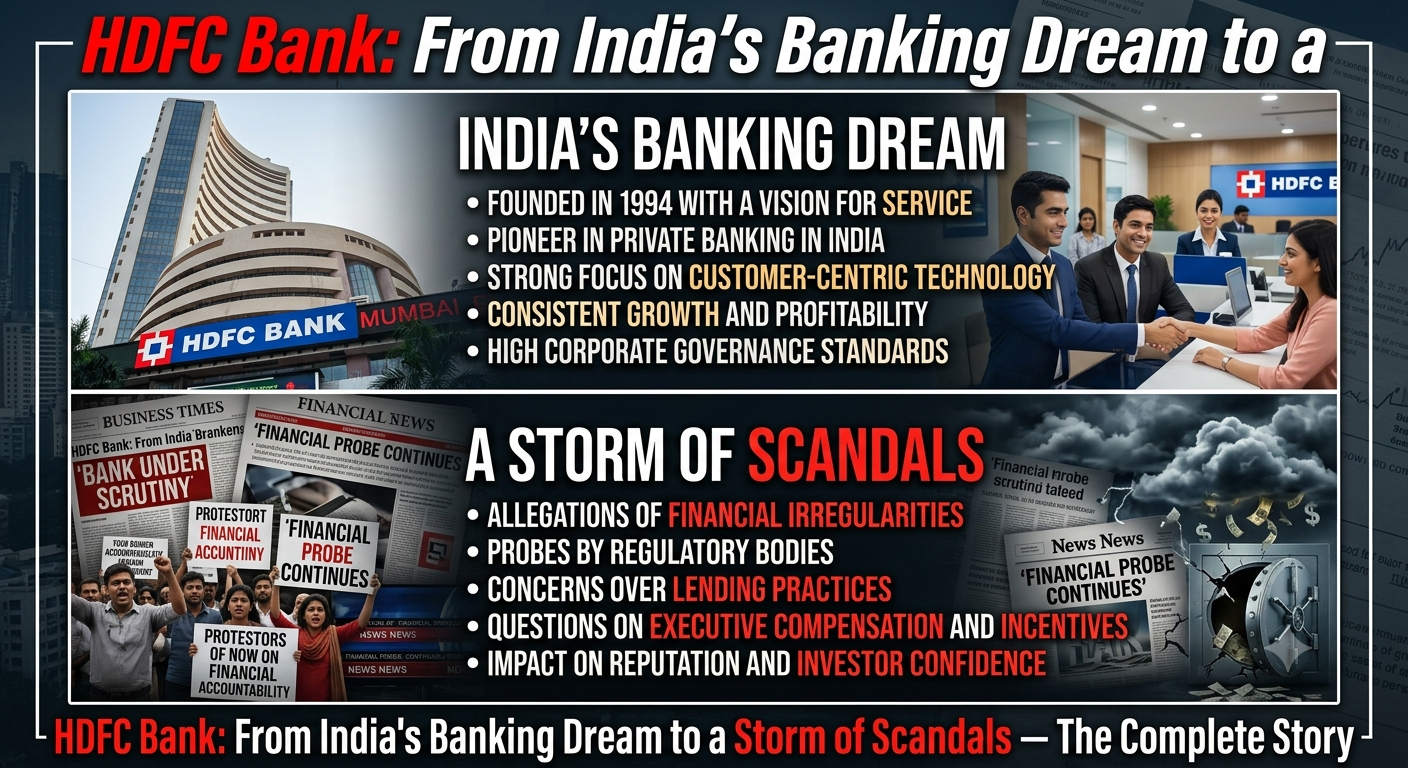
HDFC Bank: From India’s Banking Dream to a Storm of Scandals — The Complete Story
From a single branch in Mumbai in 1995 to one of the world’s largest banks — and now, a governance crisis, a crashing stock, and US securities investigators knocking on the door. This is HDFC Bank’s full story.
🗺️ THE COMPLETE HDFC TIMELINE MAP
1977 ──► HDFC Ltd. Founded (Housing Finance)
1994 ──► HDFC Bank Incorporated
1995 ──► First Branch Opens, Mumbai (Feb)
1999 ──► India's First International Debit Card
2000 ──► Merger with Times Bank (India's first voluntary bank merger)
2001 ──► Credit Card Business Launched
2008 ──► Merger with Centurion Bank of Punjab
2010 ──► 50/50 Retail-Corporate Split; 20%+ Annual Profit Growth
2015 ──► 10-Second Instant Loan Product Launched
2020 ──► RBI Penalizes Bank for IT Outages; Digital Product Freeze
2022 ──► HDFC Ltd + HDFC Bank Merger Announced (April 4)
2023 ──► $40 Billion Mega-Merger Completed (July 1)
2024 ──► Post-Merger Pressures: NIM Compression, High LDR
2025 ──► Stock Peaks at ₹1,020 (Oct); Bonus Share Issue (Aug)
2026 ──► Chairman Resigns → Internal Probe → US Investigation → Stock -26%
🏦 CHAPTER 1: THE BIRTH OF A BANKING GIANT (1977–2000)
The HDFC story doesn’t begin in 1994. It begins in 1977, when Hasmukhbhai Parekh founded the Housing Development Finance Corporation (HDFC Ltd.) with a singular dream — to make home ownership accessible to middle-class India. For nearly two decades, HDFC Ltd. became the gold standard of housing finance in the country.
Then came 1991 — India’s historic economic liberalization. The government threw open the banking sector to private players, and HDFC Ltd. seized the moment. In August 1994, HDFC Bank was formally incorporated with RBI approval. In February 1995, its first branch opened at Ramon House, Churchgate, Mumbai — inaugurated by none other than then Finance Minister Manmohan Singh.
The man who would define the bank for the next 26 years, Aditya Puri, took charge as founding CEO. His philosophy was simple but powerful: disciplined risk management, profitability over growth, and customer obsession. These principles would become HDFC Bank’s DNA.
Key early milestones:
- 1999 — Launched India’s first international debit card
- 2000 — Completed India’s first-ever voluntary bank merger with Times Bank
- 2001 — Entered the credit card business
- 2008 — Acquired Centurion Bank of Punjab for ₹9,510 crore, dramatically expanding its Northern and Western India footprint
By 2010, HDFC Bank was India’s most admired private sector bank — a perfect 50/50 retail-corporate lending split, net profit growing over 20% annually, and a conservative culture that kept NPAs (bad loans) among the lowest in the industry.
📈 CHAPTER 2: THE GOLDEN ERA (2010–2022)
Through the 2010s, HDFC Bank was the darling of Dalal Street and Wall Street alike. Foreign institutional investors poured money in. The stock climbed relentlessly. Year after year, it delivered consistent earnings growth that other Indian banks could only dream of.
During this period HDFC Bank became:
- India’s largest private sector bank
- One of the most valuable companies on Indian stock exchanges
- A global benchmark for emerging market banking
It also pioneered digital banking in India — launching the 10-second personal loan in 2015, building the EVA AI chatbot, and rolling out its PayZapp digital wallet platform.
But not everything was smooth. Between 2020 and 2022, the RBI penalized HDFC Bank multiple times for repeated internet banking outages. The regulator took the extraordinary step of banning HDFC Bank from issuing new credit cards and launching new digital products — a humiliating setback for a bank known for its technology. HDFC Bank was forced into a costly technology rebuild, what it called “Digital 2.0.”
The ban was eventually lifted, but the episode exposed a crack in the armor — HDFC Bank’s infrastructure had not kept pace with its ambitions.
💥 CHAPTER 3: THE MEGA MERGER — AMBITION OR OVERREACH? (2022–2023)
On April 4, 2022, HDFC Bank made the most audacious move in Indian corporate history: it announced a reverse merger with its own parent, HDFC Ltd. — a $40 billion deal that stunned the financial world.
The rationale was compelling:
- HDFC Ltd.’s deep mortgage expertise + HDFC Bank’s massive distribution network
- Cross-sell opportunity: 70% of HDFC Ltd. customers had no HDFC Bank account
- 93% of HDFC Bank’s 71 million customers had no mortgage with HDFC Ltd.
- Regulatory benefits — lower reserve ratio requirements post-merger
On July 1, 2023, the merger became effective — creating the world’s fourth-largest bank by market value, behind only JPMorgan, ICBC, and Bank of America. It was the largest merger in Indian corporate history. HDFC Ltd. shareholders received 42 HDFC Bank shares for every 25 HDFC Ltd. shares held.
CEO Sashi Jagdishan called it “a defining event in our journey.”
But behind the celebration lay a massive integration challenge. The bank had just swallowed a ₹3.3–3.5 trillion mortgage book. And the real pressures were only beginning to surface.
📉 CHAPTER 4: THE CRACKS BEGIN TO SHOW (2023–2025)
Post-merger, HDFC Bank faced a serious structural problem: its Loan-to-Deposit Ratio (LDR) had shot up to 96% — dangerously high. For every ₹100 it held in deposits, it had lent out ₹96. Regulators and analysts grew uncomfortable.
The bank’s management acknowledged the issue openly. The strategic goal for FY26: grow loans in line with the market while bringing the LDR down below 90%, targeting the 85–90% range by FY27.
Meanwhile, other cracks appeared:
- Net Interest Margin (NIM) — the core profitability metric — began compressing, falling to 3.26% in Q1 FY27
- Loan growth was impressive (15.4% in gross advances) but net interest income grew only 6.7% — the bigger loan book wasn’t generating proportional income
- FII (Foreign Institutional Investor) outflows accelerated — over ₹1.19 lakh crore withdrawn from Indian equities year-to-date in 2026
In August 2025, the bank issued a 1:1 bonus share — one free share for every existing share held — which confused many retail investors when adjusted stock prices appeared to show a steeper decline than actual.
The 52-week high of ₹1,020.4 was touched in October 2025. It would never return there.
🔥 CHAPTER 5: THE GOVERNANCE EARTHQUAKE (March 2026)
On March 18, 2026, HDFC Bank’s part-time Chairman Atanu Chakraborty dropped a bombshell. He resigned — and he didn’t go quietly.
His resignation letter read:
“Certain happenings and practices within the bank that I have observed over the last two years are not in congruence with my personal values and ethics. This is the basis of my aforementioned decision.”
The markets reacted with panic. The next day, HDFC Bank’s stock fell 9% intraday, wiping out nearly ₹1 lakh crore in market capitalization in a single session. The Bank Nifty index dropped nearly 1,900 points in one session — what analysts later called a “Black Thursday” for Indian banking.
An independent legal review into the issues flagged by the former chairman was ordered. But investor confidence was severely shaken.
Then came the second blow.
🕵️ CHAPTER 6: THE ₹45 CRORE HIDDEN PAYMENTS SCANDAL (May 2026)
On May 27, 2026, The Indian Express published a bombshell investigative report. It alleged that HDFC Bank’s Audit Committee had ordered an Internal Vigilance Investigation into payments totaling ₹45 crore made to the Maharashtra State Road Development Corporation (MSRDC).
The allegation: these payments were disguised as marketing spend — specifically, framed as sponsorship expenses for road safety campaigns — when in reality they were used to offer higher-than-permitted interest rates to incentivize MSRDC to make large deposits with the bank. The Reserve Bank of India strictly prohibits banks from offering negotiated interest rates to specific depositors in this manner.
On the day of publication, HDFC Bank’s stock fell 4.1%, closing at $23.78 per share on the NYSE (as HDB ADRs).
HDFC Bank issued a clarification, calling the internal audit process routine and denying any wrongdoing. But the damage to sentiment was done.
CHAPTER 7: USA COMES KNOCKING — THE SECURITIES INVESTIGATION (July 2026)
Because HDFC Bank’s American Depositary Receipts (ADRs) are listed on the New York Stock Exchange (NYSE: HDB), the bank falls under US federal securities disclosure laws. And when US investors lose money due to allegedly misleading disclosures, American law firms take notice.
By July 2026, three major US securities law firms had launched investigations:
| Law Firm | Focus |
|---|---|
| Glancy Prongay Wolke & Rotter LLP | Possible violations of US federal securities laws |
| Law Offices of Howard G. Smith | Alleged disclosure lapses to US investors |
| Law Offices of Frank R. Cruz | Materially misleading statements to shareholders |
The investigations center on a core question: Did HDFC Bank or its executives make materially misleading statements or fail to disclose material information to investors — information that caused US ADR holders to suffer losses?
HDFC Bank dismissed the probes, telling CNBC-TV18 that such notices were common in the US after a stock price decline. The bank noted that this was not its first brush with US law firms — in 2020, the Rosen Law Firm had filed a securities class action lawsuit over the bank’s vehicle loan portfolio and internal controls (which was later settled).
Supreme Court advocate HP Ranina noted that these investigations were a “preliminary exercise to assess whether there is sufficient evidence to approach the court” — not yet formal lawsuits or regulatory action.
But for investors, the message was clear: HDFC Bank is now under a microscope on two continents.
📊 CHAPTER 8: WHERE THE STOCK STANDS TODAY (August 2026)
The numbers tell a stark story:
| Timeframe | Stock Performance |
|---|---|
| 52-Week High (Oct 2025) | ₹1,020.4 |
| 52-Week Low (Jan 2025) | ₹812.1 |
| YTD 2026 | -26% |
| 1 Year | -24% |
| 3 Years | -7% |
| Analyst Target Range 2026 | ₹940 – ₹1,100 |
Analyst community is split:
- Bulls argue the governance issues are transient, core fundamentals remain strong, and the stock is at a deep value buy
- Bears say patience is warranted — the LDR is still elevated, NIM compression continues, FII outflows are relentless, and the US investigations add a new layer of uncertainty
🗺️ THE FULL CRISIS MAP
TRIGGER 1: Post-Merger Integration Stress (2023–2025)
    └── High LDR (96%) → NIM Compression → Slower Profit Growth

TRIGGER 2: Digital & Regulatory History (2020–2022)
    └── RBI Penalties for Outages → Product Bans → Trust Erosion

TRIGGER 3: Chairman Resignation (March 18, 2026)
    └── "Values and Ethics" Conflict → Stock -9% in 1 Day
    └── ₹1 Lakh Crore Market Cap Wiped

TRIGGER 4: ₹45 Crore Hidden Payments Allegation (May 27, 2026)
    └── Internal Vigilance Probe Revealed
    └── Marketing Spend Disguise for Higher Interest Payments
    └── ADR Falls 4.1% on NYSE

TRIGGER 5: US Securities Investigation (July 2026)
    └── 3 Law Firms Investigating
    └── NYSE ADR Holders Invited to Join Claims
    └── Potential Federal Securities Law Violations

MACRO OVERLAY:
    └── FII Outflows: ₹1.19 Lakh Crore in 2026
    └── West Asia Geopolitical Tensions
    └── Global Risk-Off Sentiment
    └── Bank Nifty -1,900 Points (Black Thursday)

RESULT: Stock Down 26% YTD 2026
🔮 CHAPTER 9: WHAT HAPPENS NEXT?
Several outcomes are possible:
Scenario A — Recovery (Bull Case) If the independent legal review clears HDFC Bank of governance wrongdoing, the US probes fizzle out without formal charges, and the LDR falls to the 85–90% target range by FY27, the stock could recover to the ₹1,000–₹1,100 analyst target range. Core fundamentals — 100 million customers, massive branch network, strong brand — remain intact.
Scenario B — Prolonged Pain (Bear Case) If the US securities investigations escalate into formal lawsuits, more internal issues surface, FII selling continues, and NIM fails to recover, the stock could see further downside below ₹800 adjusted levels. Trust, once broken in banking, takes years to rebuild.
Scenario C — Regulatory Intervention If the RBI finds merit in the MSRDC payment allegations and takes formal action, it could compound the bank’s woes significantly — similar to the 2020 digital product freeze.
💡 KEY LESSONS FROM THE HDFC STORY
- Size creates complexity — The $40 billion merger created a banking giant but also introduced integration risks that took years to fully manifest.
- Governance is everything in banking — A single chairman’s resignation letter destroyed more value in 24 hours than years of bad quarterly results.
- Global listings = global accountability — NYSE-listed ADRs mean US securities law applies. What happens in Mumbai doesn’t stay in Mumbai.
- Post-merger patience is essential — Investors who understood the LDR normalization story knew short-term pain was expected. Those who didn’t panicked.
- Transparency builds trust; opacity destroys it — The disguised payment allegations, whether proven or not, highlighted the reputational cost of opacity.
📌 CONCLUSION
HDFC Bank’s story is one of India’s greatest corporate success stories — and now, one of its most cautionary tales in the making. From a single branch in 1995 to the world’s fourth-largest bank by market cap, the journey was extraordinary. But the convergence of post-merger integration pressure, a governance crisis, an internal payments scandal, and US securities investigations has created a perfect storm that has wiped 26% off the stock in 2026 alone.
The next 12 months will be defining. Will HDFC Bank emerge from this crucible stronger — as it did after the RBI digital ban of 2020? Or is this the beginning of a longer, deeper reckoning?
India’s banking sector, its 42 lakh shareholders, and investors on two continents are watching.
Disclaimer: This blog is for informational purposes only and does not constitute financial or investment advice. Stock prices and regulatory situations are subject to change.
HDFC Bank: Deep Investigation and Analysis of Current Situations
How to find top 5 largest files in directories on Linux/Unix
If you would like to learn via video, please do click on it:
HDFC बैंक लोन: आवेदन से पहले ये बातें जानना है ज़रूरी!