
How Axis MF’s Chief Dealer & His Friends Allegedly Scammed the Market Through Front-Running
A plain-English breakdown of one of the biggest front-running cases to hit Indian mutual funds—what happened, how the scheme allegedly worked, and what it means for ordinary investors.
When you hand your money to a mutual fund, you trust that the people managing it are working *for* you—not trading against you. The Axis Mutual Fund case is a stark reminder of what can go wrong when someone on the inside decides to put their own profits first.
At the center of it was **Viresh Joshi**, the Chief Dealer at Axis Asset Management Company (Axis Mutual Fund)—the person whose job was to execute the fund’s massive buy and sell orders. According to the market regulator SEBI, he allegedly used that front-row seat to the fund’s order flow to enrich himself and a web of connected people. This is what “front-running” looks like in the real world.
The Axis Mutual Fund front-running scam—uncovered through automated surveillance alerts and investigated by the Securities and Exchange Board of India (SEBI)—stands as one of the most prominent insider trading and market abuse cases in recent Indian financial history.
Quick disclaimer:
The details below are based on SEBI’s interim order and public reporting. These are *allegations and interim findings*; the individuals named have the right to contest them. Nothing here is a final verdict.
First, what is front-running?
Imagine you work at a restaurant and you overhear that a food critic is about to give a tiny, unknown bakery a five-star review tomorrow. Before the review goes public, you rush out and buy a big stake in that bakery. When the glowing review lands and everyone piles in, the value shoots up — and you cash out. You didn’t do anything to earn that gain; you just **traded ahead of information only you had.**
In the stock market, front-running is exactly that, but with a twist that makes it especially damaging: the person doing it often **creates** the price move they’re betting on.
Here’s the key: mutual funds trade in enormous volumes. When a big fund places a huge **buy** order for a stock, that demand pushes the price **up**. When it places a huge **sell** order, the price gets pushed **down**. Anyone who knows those orders are coming can profit with almost no risk:
– **Buy** the stock *just before* the fund’s big buy → the fund’s order lifts the price → sell into it for a quick gain.
– **Sell / short** the stock *just before* the fund’s big sell → the price drops → buy back cheaper.
The dealer knows the fund’s moves before anyone else. That’s the unfair edge.
The person in the chair: the Chief Dealer
A **dealer** at a mutual fund is the one who actually presses the buttons—placing the fund’s trades in the market. The **Chief Dealer** sees the full picture of what the fund is about to buy or sell, often minutes or hours before those orders hit the exchange.
That makes it one of the most sensitive, trust-dependent seats in the entire operation. Viresh Joshi sat in that seat at Axis MF. And that advance knowledge of order flow is precisely what SEBI alleges was misused.
Core Mechanics of the Scam
Front-running occurs when an individual with confidential, non-public knowledge of an impending large institutional trade places personal orders ahead of that transaction to capture risk-free profits. Because mutual funds buy or sell massive quantities of shares, their orders naturally drive stock prices upward or downward.
In this case, the operation ran through a synchronized multi-layered network:
-
The Insider Leak: Viresh Joshi, serving as the Chief Dealer at Axis Mutual Fund, possessed privileged visibility into impending bulk orders (the “Big Client” trades). Instead of maintaining confidentiality, Joshi leaked these non-public details regarding stock names, quantities, and execution timing to external operators.
-
The Network of Conspirators & Intermediaries: Intermediaries like Sumit Desai, Pranav Vora, and Vaibhav Pandya helped coordinate secondary trading accounts, arrange brokerage terminals, and bridge communications.
-
The Executioner & Offshore Routing: Prijesh Kurani, based in Dubai, acted as an executioner, using a network of proxy, “mule,” or conduit accounts to punch in orders just moments before Axis MF’s institutional orders hit the exchange.
-
The Pattern & Profit Siphon: The accounts executed precise “Buy-Buy-Sell” or “Sell-Sell-Buy” patterns. Once Axis MF’s massive trades moved the market price, the conduit accounts instantly squared off their positions to lock in profits, later routing the gains through complex financial structures (including overseas setups and traditional cash networks).
How the alleged scheme worked
Based on SEBI’s findings, the pattern looked something like this:
1. **The tip-off.** Knowing that Axis MF was about to place a large order in a particular stock, information about that impending trade allegedly reached a network of connected entities—described in the video’s framing as “his friends,” but in practice a set of associates and linked accounts.
2. **The head start.** These connected accounts would trade in that stock *ahead* of the fund’s order.
3. **The fund moves the price.** Axis MF’s large order would then execute, nudging the stock’s price in the expected direction.
4. **The cash-out.** The connected accounts would unwind their positions into that price move—booking a near-riskless profit that effectively came at the expense of the fund (and therefore its investors).
Repeat this across many stocks and many trades, and small edges compound into very large numbers.
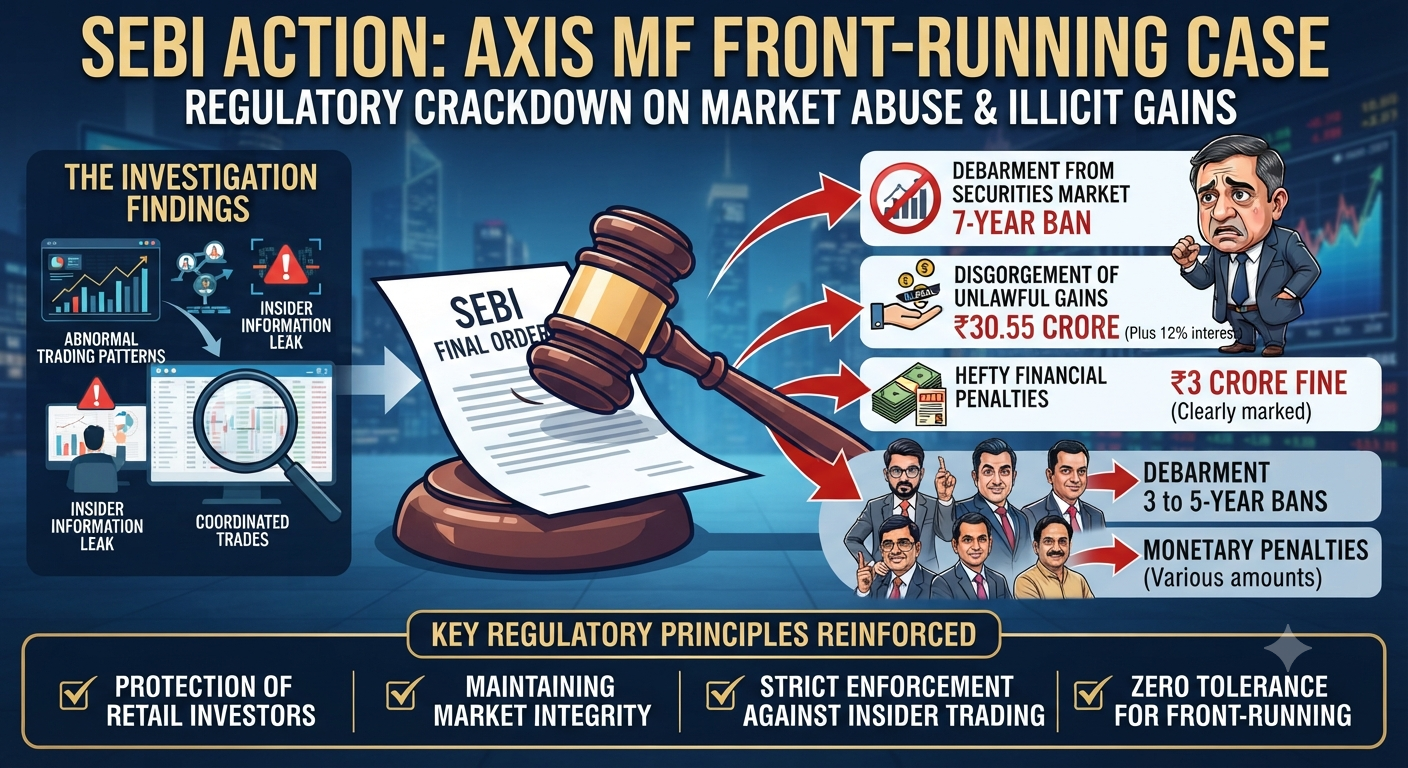
Regulatory Crackdown and SEBI’s Final Order
Following extensive investigations into trading activity spanning from late 2021 into 2022, SEBI issued comprehensive rulings holding the key actors accountable for violating Prohibition of Fraudulent and Unfair Trade Practices (PFUTP) norms:
-
Disgorgement of Unlawful Gains: SEBI directed the involved entities to account for ₹30.55 crore in wrongful gains generated through the scheme, alongside mandated 12% annual interest.
-
Market Bans and Penalties: SEBI barred former Chief Dealer Viresh Joshi, Dubai-based Prijesh Kurani, and key members of the Kurani group from accessing the securities market for seven years. Other facilitators and proxy account entities received debarments ranging from three to five years. Hefty personal financial penalties—including ₹3 crore on Joshi and ₹1 crore on Kurani, alongside fines on other participating entities—were officially levied.
Covering the tracks
What turns an ordinary conflict of interest into an alleged scam is the effort to hide it. According to SEBI’s order and reporting around the case, the scheme allegedly leaned on tactics such as:
– **Connected and “mule” accounts**—trading through relatives, associates, and other people’s accounts rather than one’s own, to break the obvious link.
– **Offshore and foreign brokerage channels**—routing activity in ways that are harder for domestic surveillance to piece together.
– **Encrypted communication**—coordinating tips through channels that don’t leave an easy paper trail.
None of that stops the regulator forever. Modern market surveillance can reconstruct who traded what and *when*, relative to a fund’s orders — and a consistent pattern of “someone always buys seconds before Axis MF does” is exactly the kind of statistical fingerprint that gets flagged.
—
SEBI’s action
Following its investigation, SEBI passed an **interim order** in the matter. In broad strokes:
– Around **21 entities—Viresh Joshi plus a network of connected persons and entities—were **barred from the securities market.
– SEBI ordered the **impounding of the alleged wrongful gains**, reported to be in the region of **₹30.5 crore**, to stop the money from being moved out of reach.
– Axis Mutual Fund had already **suspended (and later parted ways with)** the executives involved once its own internal review flagged irregularities in 2022.
An interim order is essentially the regulator hitting pause—freezing the situation and the money—while the full investigation and legal process play out.
*(Exact figures, entity counts, and dates should be confirmed against the latest SEBI order and news coverage before you publish—see the note at the end.)*
—
Why this matters to ordinary investors
It’s easy to read this as insider drama between traders. But front-running has real victims:
– **The fund’s investors pay for it.** When someone front-runs a fund’s order, they nudge the price *before* the fund buys—so the fund ends up buying slightly higher (or selling slightly lower). Those tiny leaks, multiplied across thousands of trades, come straight out of the returns belonging to everyday unit holders.
– **It corrodes trust.** The entire mutual fund model rests on the promise that professionals will act in investors’ interest. Cases like this are why that trust has to be enforced, not assumed.
Are your mutual funds safe?
Mostly, yes—and cases like this are actually the *system working*, catching wrongdoing and acting on it. But it’s worth understanding the guardrails:
Segregation of duties & surveillance.
Fund houses and exchanges monitor trading patterns precisely to catch this behavior.
SEBI oversight.
The regulator’s ability to trace, freeze, and penalize is a real deterrent.
Your own diligence.
Stick with fund houses that respond transparently when problems surface. Notably, when irregularities emerged, Axis MF launched a review and suspended the individuals rather than looking away.
The takeaway isn’t “mutual funds are rigged.” It’s that **oversight is essential**, and this case shows both the risk *and* the response.
The bottom line
The Axis MF episode is a textbook example of how privileged information, in the wrong hands, becomes an unfair weapon. A chief dealer had a clear view of a giant fund’s next moves — and, per SEBI, that view was allegedly turned into private profit through a network of connected accounts and careful concealment.
For investors, the lesson is simple: the markets run on trust, and trust runs on enforcement. The fact that surveillance caught the pattern, the regulator froze the gains, and the fund house acted is exactly why the system, despite its flaws, still holds.
FAQ
**What is front-running in simple terms?**
Trading on advance knowledge of a large upcoming order so you can profit from the price move that order will cause—before anyone else can react.
**Is front-running illegal in India?**
Yes. It’s treated as a fraudulent and unfair trade practice under SEBI’s regulations and can lead to market bans and impounding of illegal gains.
**Who was Viresh Joshi?**
The Chief Dealer at Axis Mutual Fund—the person responsible for executing the fund’s trades—who SEBI alleges misused knowledge of the fund’s order flow.
**Did investors lose money?**
Front-running quietly erodes a fund’s execution quality, which ultimately affects the returns of its unit holders. The precise investor-level impact is part of what such investigations assess.
What did SEBI do about it?
SEBI passed an interim order barring the connected entities from the market and impounding the alleged wrongful gains while the full case proceeds.
This article is for general information and does not constitute financial or legal advice. All wrongdoing described is alleged and subject to due process.
Motilal Oswal Nasdaq 100 FoF Direct Growth
SEBI order against:
Order PDF: