
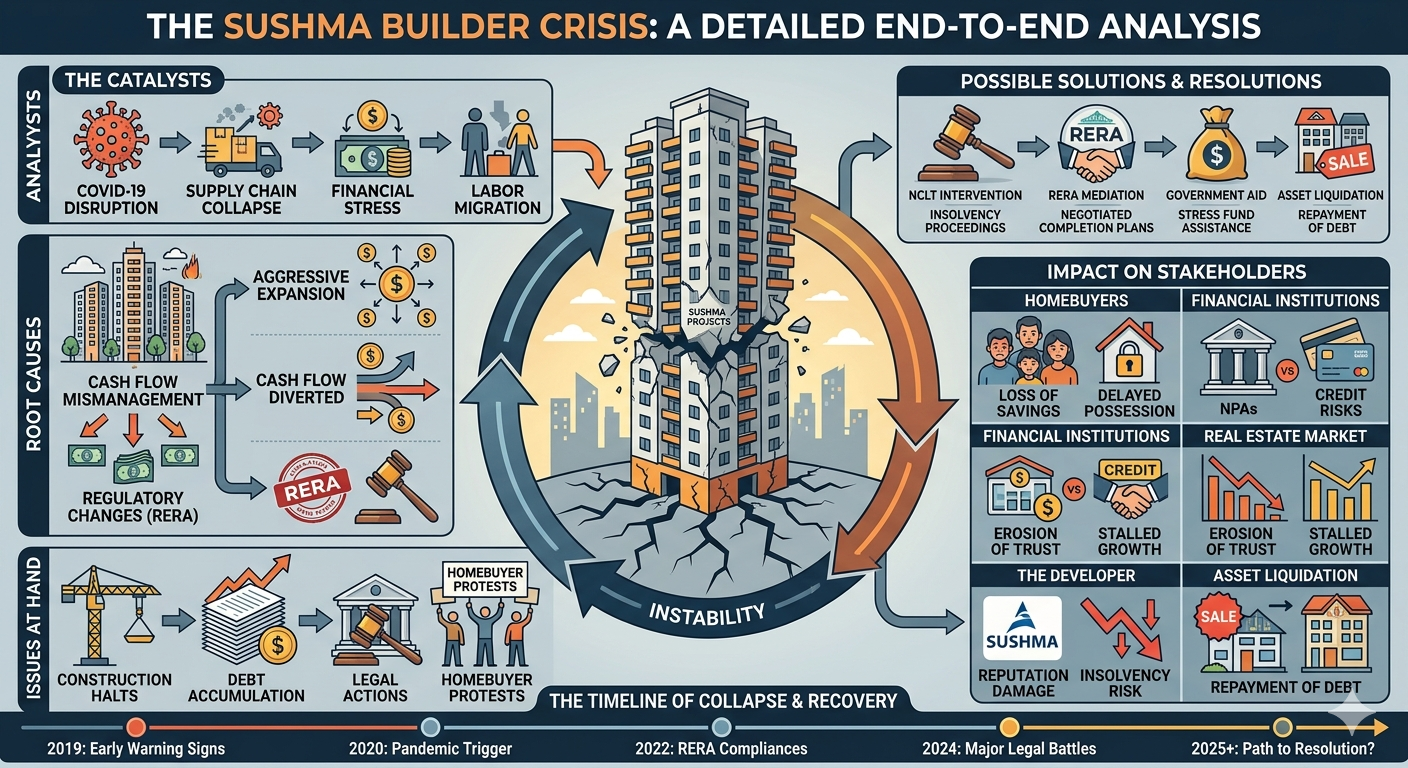
The Sushma Builder Crisis: A Detailed End‑to‑End Analysis
1. Executive Summary: The Anatomy of a Collapse
The crisis surrounding Sushma Buildtech is a complex interplay of overambitious expansion, alleged financial mismanagement, and regulatory failures, leading to a catastrophic collapse in project delivery. The situation is characterized by massive construction delays affecting thousands of units, multiple legal actions—including non-bailable warrants against directors—and a breakdown in trust between the builder and its customers. The current landscape is defined by judicial intervention, with courts attempting to balance the recovery of homebuyers with the company’s survival.
2. Phase I: Path to Crisis (Primary Issues & Catalysts)
The crisis didn’t emerge overnight; it was built upon a foundation of fundamental operational and financial miscalculations.
A. Systemic Project Delays and Non-Delivery
This is the most critical issue affecting stakeholders. The core business model of delivering completed properties has failed.
-
Magnitude: Numerous residential and commercial projects across Zirakpur and Mohali, promised for completion between 2017 and 2022, remain unfinished or lack essential statutory certificates (Occupancy Certificates – OC).
-
Key Affected Projects: Complaints and litigation are concentrated around major developments such as:
-
Sushma Grande and Sushma Grande NXT (Zirakpur)
-
Sushma Crescent (Dhakoli)
-
Sushma Valencia (Zirakpur)
-
Sushma Chandigarh Grande (Bishangarh)
-
Sushma Infinium (Commercial – Zirakpur)
-
-
Stalled Construction: Activity on many sites has been reported as minimal or non-existent due to non-payment of contractors, laborers, and material suppliers.
B. Severe Capital Crunch and Revenue Collapse
The underlying driver of the delays is a profound lack of liquidity.
-
Depleted Funds: The company ran out of the capital required to continue construction across its vast portfolio.
-
Alleged Fund Diversion: A persistent allegation from buyer associations is that funds collected from existing buyers were diverted to acquire new land parcels or cross-subsidize other distressed projects, preventing any single project from reaching completion.
-
Unpaid Government Dues: Reports indicate the builder has significant outstanding dues with local planning authorities (e.g., GMADA) and service providers, which has legally blocked the issuance of final OCs even for physically completed units.
C. Breakdown of Amenities and Possession Quality
Where possession was offered, often prematurely under pressure, buyers have faced poor living conditions.
-
Lack of Basics: Resident protests have occurred over missing statutory services, including reliable power connections (reliant on temporary gensets), inadequate sewage systems, and unmaintained common areas.
-
Safety Concerns: The lack of necessary Fire Safety NOCs (No Objection Certificates) is a major sticking point in legal battles.
3. Phase II: The Crisis Peak (Stakeholder Impact)
The culmination of these issues has had devastating consequences across the real estate ecosystem.
A. Impact on Homebuyers
The homebuyers are the primary victims, facing financial and emotional ruin.
-
Dual Financial Burden: Many are simultaneously paying EMIs on home loans and rent for their current housing.
-
Loss of Life Savings: For thousands, their entire retirement or life savings are locked into stalled projects with no clear timeline for recovery.
-
Mental Agony: The constant uncertainty, failed promises, and arduous legal battles have caused immense trauma.
B. Market Impact ( Chandigarh Tricity)
The crisis has sent shockwaves through the regional real estate market.
-
Crisis of Confidence: The failure of a major developer severely erodes trust in the under-construction market, making buyers wary of other local players.
-
Supply Glut: Thousands of incomplete and disputed units act as a burden on the market, contributing to price stagnation in specific micro-markets like Zirakpur and Dhakoli.
C. Regulatory Strain
RERA Punjab and Consumer Courts are being overwhelmed by complaints against Sushma Buildtech. The case serves as a benchmark for testing the enforcement capabilities of the Real Estate (Regulation and Development) Act.
4. Phase III: Judicial Enforcement and Resolution Paths (Current Status)
The crisis has now moved entirely into the judicial sphere, where the focus has shifted from voluntary recovery to forced compliance.
A. The Consumer Forum Crackdown
In March 2026, the State Consumer Disputes Redressal Commission, Chandigarh, took severe action.
-
Non-Bailable Warrants: The Commission issued non-bailable warrants (NBWs) against the directors of the company for non-compliance with its orders to refund or hand over possession to several aggrieved homebuyers. This serves as a potent coercive tool.
B. High Court Intervention: Balancing Act
The Punjab and Haryana High Court has been involved to prevent a complete collapse that would benefit no one.
-
Attachment and Freezing of Accounts: To ensure recovery, courts initially ordered the attachment of the builder’s projects and the freezing of its bank accounts.
-
Strategic Unfreezing (March 2026): In a landmark order, the High Court allowed the partial unfreezing of specific bank accounts. The Court recognized that continued freezing would ensure the company’s collapse, preventing it from generating revenue to finish projects or repay debts.
-
Stringent Repayment Conditions: The unfreezing was granted on a strict condition that the builder would refund 50% of the principal amount to a specific group of homebuyers within four months (25% in 2 months, 25% in 4 months), failing which they would face contempt proceedings.
C. RERA Proceedings (Punjab)
RERA Punjab continues to pass orders for delayed possession interest and refunds under Section 18 of the RERA Act. RERA has also issued execution certificates to recover these dues through district collectors, adding further pressure.
5. End-State Scenarios: Future Outlook
The trajectory of the Sushma crisis over the next 12 months is expected to resolve into one of three primary scenarios.
| Scenario | Description | Likely Trigger | Impact on Buyers |
| Scenario 1: Judicially-Managed Recovery | The builder meets the strict refund deadlines set by the High Court and generates enough cash flow from existing inventory sales to complete 2-3 near-finished projects. | Sale of large commercial assets or undeveloped land parcels. | Partial refunds for many; slow possession for others. Minimal trust is restored. |
| Scenario 2: NCLT/Insolvency | If the builder fails to meet the repayment schedule, or if another financial creditor (bank) loses patience, the company enters Corporate Insolvency Resolution Process (CIRP) under the IBC. | Failure of Scenario 1, or petition by a major lender. | A new developer/investor is sought to take over. Highly uncertain timeline (1.5 – 3 years+), but offers a chance for project completion. |
| Scenario 3: Complete Liquidation | No viable buyer or resolution plan is found for the company. | Collapse of the NCLT process. | Worst Case. Company assets are auctioned, and buyers receive pennies on the rupee after years of litigation, as they are unsecured creditors. |