
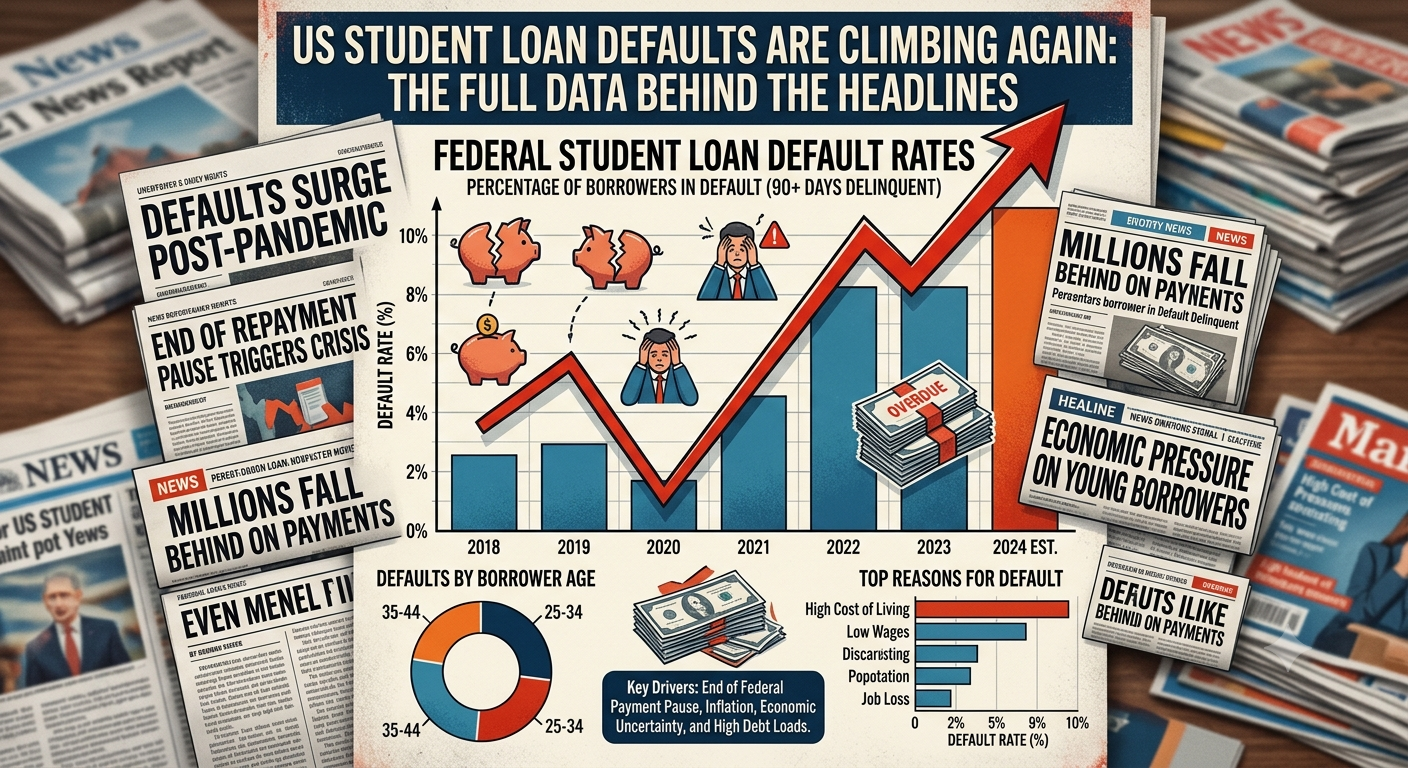

US Student Loan Defaults Are Climbing Again: The Full Data Behind the Headlines
A close look at what the Federal Reserve’s own numbers actually show — where the crisis is real, where the headlines oversimplify, and who’s paying the price.
The Headline Number: US Student Loan Defaults 2026: Full Data & Analysis (US)
In the first quarter of 2026, roughly 2.6 million federal student loan borrowers who were more than 120 days past due had their loans transferred to the Department of Education’s Default Resolution Group. That followed about 1 million borrowers who defaulted in the final quarter of 2025.
Put together, an estimated 7.7 million borrowers now sit in outright legal default on federal student loans—the first time defaults have shown up on credit reports at scale since the pandemic payment pause began in March 2020.
This isn’t a rumor or a projection. It’s what the Federal Reserve Bank of New York’s own Quarterly Report on Household Debt and Credit, and a companion Liberty Street Economics research post, actually show. Here’s the evidence, in order.
Chart 1: The Delinquency Rate, Quarter by Quarter: US Student Loan Defaults 2026.

During the pandemic-era payment pause, federal student loan delinquency was artificially suppressed to near zero — around 0.5% — because nobody was technically required to pay, so nobody could technically be “late.” That’s not a sign of borrower health; it’s a sign the clock was stopped.
Once repayment fully restarted and the Education Department resumed reporting missed payments to credit bureaus, the real picture reappeared fast:
- 2025 Q4: 9.6% of student loan balances were 90+ days delinquent
- 2026 Q1: 10.3%
- 2026 Q2: 10.6%
That’s a climb of roughly 10 percentage points in under two years, from a pandemic-distorted baseline to a rate that has now matched or exceeded pre-pandemic norms, depending on which historical benchmark you use.
The Nuance the Headlines Usually Skip
Here’s where a careful read of the data adds something the “student loans are spiraling out of control” headlines tend to miss: there’s a difference between the total stock of delinquent debt and the rate of new borrowers falling behind.
The stock — the 10.6% figure above — kept rising through Q2 2026. But the New York Fed also tracks a separate, forward-looking metric: the rate at which currently performing balances newly transition into serious delinquency each quarter. That number tells a different story:
- One measure of this transition rate fell to 7.83% in Q2 2026, down from 12.88% in the same quarter a year earlier
- A related four-quarter measure fell from 16.2% in late 2025 to 10.9% by early 2026
In plain terms: the pace at which new borrowers are falling into trouble appears to be slowing, even though the total pile of already-delinquent debt hasn’t shrunk yet. That’s consistent with a one-time “restart shock” working its way through the system—the initial wave of borrowers who fell behind once the pause ended and reporting resumed—rather than a runaway trend that keeps accelerating indefinitely.
Both things are true at once: the overhang is real and still elevated, and the pace of new damage looks like it’s cresting rather than snowballing. A responsible read of this data holds both facts together instead of picking whichever one fits a more dramatic narrative.
Who’s Actually Defaulting: US Student Loan Defaults 2026: Full Data & Analysis (US)
The Fed’s borrower-level data (matched against Equifax credit records) paints a specific, non-random picture of who makes up these 7.7 million defaults:
- Average age of a newly-defaulted borrower: nearly 39 years old—these are not fresh graduates; many are a decade or more into their careers
- Most were current on their loans before the pandemic pause began—this isn’t primarily people who were already struggling; it’s people the four-year pause left unprepared for repayment to restart
- Credit scores for defaulted borrowers fell by 91 points on average—enough to move many from “fair” credit into “poor” credit territory in a single reporting cycle
- Defaults are geographically concentrated in Southern states, which the research links to lower median incomes, fewer state-level borrower protections, and—historically—higher rates of enrollment at for-profit colleges, whose alumni default at disproportionately higher rates than public or nonprofit school graduates
Chart 2: Default Doesn’t Stay Contained to Student Loans

This is arguably the most important — and least reported — part of the data. The New York Fed didn’t just look at student debt in isolation; it checked what else these newly defaulted borrowers owed elsewhere. As of Q1 2026, among borrowers who had just defaulted on a federal student loan:
- 56% were also past due on at least one credit card
- 40% were also past due on an auto loan
- 20% were also past due on a mortgage
These borrowers had modestly improving delinquency rates on other debts during the pandemic—the same as the general population. It’s only after the student loan pause ended that their overall credit health cratered across the board. That sequencing matters: it suggests the student loan restart itself, not some separate, unrelated financial event, is the trigger dragging down these other accounts.
The Part That Hasn’t Happened Yet
Everything above describes damage that’s already occurred. There’s a second wave still ahead. Collections activity on defaulted federal loans is currently paused — but that pause is not permanent. When it lifts, the Department of Education can legally pursue the following:
- Wage garnishment — a portion of a borrower’s paycheck withheld directly
- Tax refund seizure — federal refunds redirected to loan repayment
- Offsets against other federal benefits
For the roughly 7.7 million people already in default, none of these consequences have fully materialized yet. The 91-point credit score hit and the cross-default numbers above reflect the situation before collections resume. If and when they do, the financial strain on this same population is positioned to intensify, not ease.
The Bottom Line
The evidence supports a specific, bounded claim—not the maximalist version that shows up in some headlines, but not a dismissible blip either:
- The stock of seriously delinquent student debt has climbed roughly 10 points since the pandemic pause ended, from near-zero to elevated levels, and was still rising as of the most recent Q2 2026 data.
- The pace of new borrowers falling behind each quarter appears to be decelerating, suggesting the sharpest part of the “restart shock” may be behind us—even as the accumulated damage remains.
- The people most affected are disproportionately older, previously current borrowers in Southern states, not primarily recent graduates or serial delinquents.
- The damage is already spreading into credit cards, auto loans, and mortgages for a majority of newly defaulted borrowers.
- The most severe consequences—wage garnishment and tax refund seizure—haven’t started yet, because collections remain paused.
Whatever policy debate follows from this data, the numbers themselves are not ambiguous: student loan repayment, unpaused after four years, is currently the single biggest driver of new credit distress in the American consumer credit system.
Top ETFs to Buy Now for Long-Term Investment Success