
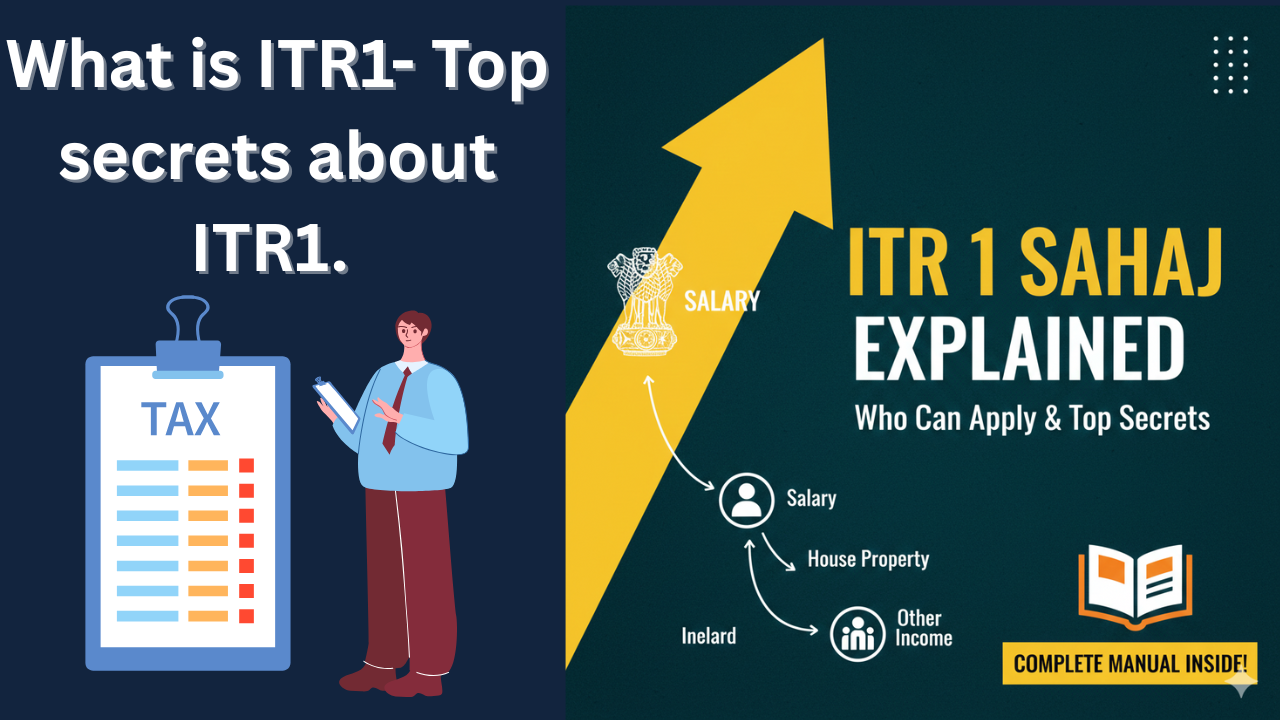
What is ITR 1? What are the top secrets of ITR 1?
The Income Tax Department has put people into categories based on how much money they make and where they get it from to make it easier for people to pay their taxes. People with salaries up to ₹50 lakh can use the ITR-1 form, which is also known as the Sahaj Form. The Income Tax (IT) Department puts people into several groups based on their income and where it comes from. The agency has numerous kinds of forms, and you need to pick the right one to file your taxes.
ITR 1 is an important form that people with an annual income of less than ₹50 lakh use to file their income tax returns. This form is also called the ITR Sahaj. Here is a brief explanation of what it includes.
A short explanation about ITR 1.
Together, let’s investigate ITR-1! After I explain what it is and who can use it, we can discuss the “secrets” that help taxpayers avoid notices and save time. Along the way, I’ll pose a few leading questions to see how this relates to your particular circumstance. 📝
ITR-1 (Sahaj): What is it? “🏛️”
Sahaj (meaning “easy”), another name for ITR-1, is the most basic income tax return form in India. It is intended for residents who have stable sources of income. Consider it a “one-page” synopsis for the typical taxpayer. +1
Who Is Eligible? ✅
1. If you fulfill all of these requirements, you can file an ITR-1:
Resident: You’re an Indian citizen, not an NRI. 🌮🇳
Income Limit: You can earn up to ₹50 Lakh in total during the fiscal year. 💰
2. Sources of revenue: The sources of your revenue are:
3. Pension or Salary. 💼
4. One house property, such as your personal residence or a rental property. 🏠
5. Other Sources (interest from dividends, FDs, or savings) 🏦
6. Up to ₹5,000 in agricultural income. 🌱
7. New for 2025–2026: If your listed equity or mutual fund capital gains are less than ₹1.25 lakh, you can now disclose them!
Who should use ITR-1?
The ITR-1 form is a single page that is much easier to fill out. If you’re not sure if you can get an ITR-1, you should know that your income must originate from one of the following sources:
1. Money you make from work or a pension.
2. Money made from one property, such as a house.
3. Money made from things that aren’t connected.
4. For persons who make less than ₹50 lakhs.
ITR-1 filing for clubbed income tax returns with a spouse or minor can only happen if the above conditions are met.
There are significant modifications to the ITR-1 form for the fiscal year 2023-24.
April 1 is the start of a new fiscal year in India. Because of this, some income tax rules that were previously mentioned in the yearly budget presentation are now being put into action. The new fiscal year (FY23), which goes from 2022 to 2023, has seen some significant changes. Some of these changes are taxing bitcoin income, making older people file ITRs, taxing PF accounts, and more.
1. Tax on profits from Bitcoin assets.
2. Seniors 75 and above don’t have to file an ITR 1.
3. TDS on perks for business.
4. You have to pay taxes on interest earned on PF accounts.
5. Gains offset losses from virtual digital assets.
6. The NPS deduction for state government workers.
7. Sending in updated ITRs.
8. People who buy affordable housing don’t receive any more tax incentives.
An overview of ITR 1.
The form has these parts:
Part A: General Information
Part B: Total Gross Income
Part C: Taxable Total Income and Deductions
Part D: How to Figure Out How Much Tax You Owe
Part E: Other Information, like information about tax deducted at source (TDS), advance or self-assessment tax, and verification
What are the requirements to file ITR 1?
The ITR Sahaj is a one-page form that people who earn less than ₹50 lakh, such as from a job or pension, from one dwelling property, or from other sources that don’t include winning a racehorse or a lottery, use. provided a single taxpayer combines the income of his spouse or minor kid, he can only do so provided his own income meets the requirements listed above.
Who Can’t Use ITR1?
These taxpayers are not authorized to file their taxes using ITR 1:
1. People who pay taxes and make more than ₹50 lakh a year.
2. Director of the company.
3. Owns unlisted equity shares.
4. People who don’t live there or who don’t usually live there. People who make money from more than one house property, legal gambling, horse racing, or the lottery; capital gains; farming income over ₹5,000; or professional or commercial revenue
5. Resident Indians with worldwide assets who want to avoid paying taxes twice under Sections 90, 90A, and 91.
How to File an ITR 1
There are two main approaches for a taxpayer to file the ITR 1 form. These are
On the web | Online mode
The person can send the information electronically and then send it to the right authorities for verification. The taxpayer can also file the return online and then use net banking, Aadhar, an electronic verification code (EVC), or a one-time password (OTP) to e-verify it. For returns that are filed electronically, the acknowledgment is sent to the address on file, or it can be obtained from the income tax website.
Not online | offline mode
https://www.incometax.gov.in/iec/foportal/downloads/income-tax-returns#itr%201
People over 80 years old or taxpayers who make less than ₹5 lakh and don’t ask for a refund can file their forms offline. The tax authorities send you a receipt when you send in the form.
Here you can see the ITR1 manual from tax ddepartment.
File ITR-1 (Sahaj) Online User Manual
https://www.incometax.gov.in/iec/foportal/help/how-to-file-itr1-form-sahaj
File ITR-4 (Sugam) Online User Manual
In conclusion
The I-T Department sends the acknowledgment document to the taxpayer’s registered e-mail ID if they choose to file their returns electronically or online. You can also obtain the same paper from the Income Tax website. Taxpayers who use the physical form to file their returns get an acknowledgment copy from the I-T Department once they send it in.
FAQ
1. Can I submit ITR 1 for agricultural income that is not taxed?
Yes, you can use this form to file your taxes if your agricultural revenue is less than ₹5,000. But if it is more than ₹5000, you have to file your returns in ITR 2.
2. How do you fill out the paperwork to report bank accounts?
During the financial year, you should list all of your savings and checking accounts. But if an account has been inactive for more than three years, the information may not be included.
3. Should income from mutual fund dividends be counted?
Yes. Section 10(35) says that money made from mutual fund investments as dividends is not taxable. But it must be shown in Part D under “Exempt Income (others).”
Now that you know what ITR Form 1 includes and what the requirements are to use it, you must use it to file your income tax returns if you meet those requirements.
4. Can I file an ITR-1 with tax-free agricultural income?
Yes! You can only file if your agricultural income is less than ₹5000. You need to file an ITR-2 if it is more than that.
5. How do you record bank accounts in ITR-1?
You need to give a lot of information about all of your current and savings accounts. If your account has been dormant for more than three years, you don’t have to say anything.
6. If you make money from renting, how do you submit ITR-1?
You have to upload Form 16 and your income details at the same time. The first stage for people who acquire rental income and want to file an ITR-1 is to enter their first name, middle name, last name, gender, date of birth, and PAN number.
7. If TDS has already been taken off, should interest income be listed under “Income from Other Sources” when you file your ITR-1?
The Income Tax Department will take the TDS (which has already been taken out) into account when calculating your ultimate tax bill. If the bank doesn’t take TDS from your fixed deposits, you must add the interest to your total income and pay taxes on it.
Important points to remember.
If you make more than ₹2.5 lakh and are under 60, you have to file your taxes. If you make more than ₹3 lakh and are between 60 and 80, you have to file your taxes. If you make more than ₹5 lakh and are above 80, you have to file your taxes.
The limits for exemptions are always changing because of government rules and notices.
Also, filing the returns is a simple process. You only need to know what the different sorts of ITR forms are and when to use them.

Income Distribution of Filers
| Income Range | % of Filers | Tax Share |
|---|---|---|
| Up to ₹5 Lakh | 47% | Minimal |
| ₹5 – ₹10 Lakh | 37% | ~13% |
| ₹10 – ₹25 Lakh | 13% | ~37% |
| Above ₹50 Lakh | 1% | 50% |
*Top 1% of individual filers contribute nearly 50% of the total collection.

AY 2024-25/25-26

AY 2024-25/25-26
[…] What is ITR 1? What are the top secrets of ITR 1? January 14, 2026 […]