
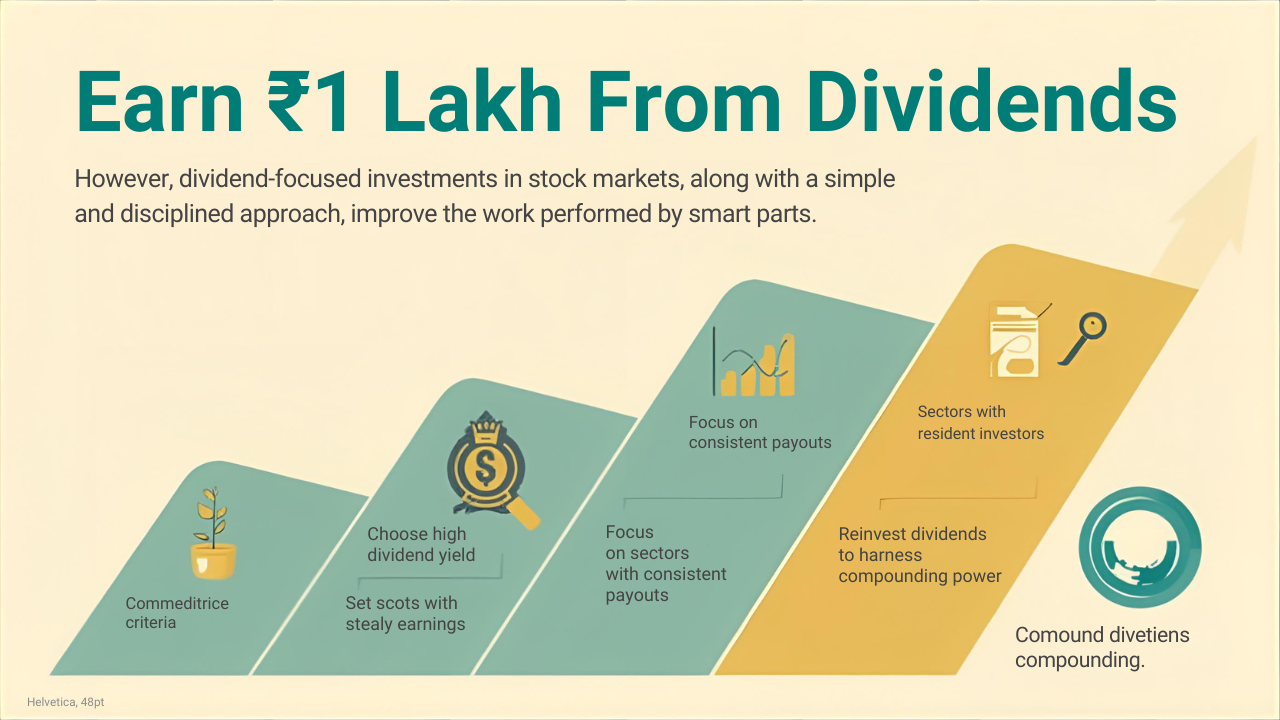
How do I make one lakh from dividends?
A lot of Indian investors find the prospect of making money without selling stocks quite intriguing. This is achievable because of dividend investment. Picture putting together a portfolio where corporations pay you to hold their shares on a regular basis, like getting “rent” from your assets. If you plan ahead, you can strive for ₹1 lakh in dividends per year. It doesn’t happen immediately away, but investors may establish a steady stream of income by choosing the correct companies that pay dividends, spreading their money across different industries, and reinvesting their payouts. Let’s look at some sensible ways to help you attain your objective of a ₹1 lakh dividend.
Getting it Income from dividends
Dividends are payments made to shareholders from a company’s profits. Some blue-chip firms in India, such as ITC, Hindustan Unilever, Infosys, and Coal India, are well-known for paying dividends on a regular basis. Most of the time, these businesses are financially secure and have steady cash flows. Investors can use the dividend yield (dividend per share ÷ current price) to figure out how much money they are making. For instance, a stock that costs ₹200 and pays a dividend of ₹10 every year has a yield of 5%. Investors need to figure out how much to invest based on yields if they want to make ₹1 lakh a year.
Find out how much you want to invest.
Let’s conduct a quick math problem to see how to make ₹1 lakh from dividends. If the average dividend yield is 3%, you would need to put in about ₹33–34 lakh. But if the yield goes up to 5%, the amount of money needed lowers a lot to about ₹20 lakh. This explains why it can help you attain your goal faster to focus on equities with higher dividend yields (as long as they are secure).
How to Pick the Best Dividend Stocks
Not every high-yield stock is a good one. Companies can pay hefty dividends only after their business slows down. So, seek for strong basic companies that have been paying dividends for at least 10 years and do so on a regular basis. Also, check that their payout ratio is healthy, which should be between 30% and 60%. ITC, Infosys, TCS, Hindustan Zinc, Power Grid, and NTPC are among of India’s most consistent dividend equities.
Creating a portfolio of dividends that is diverse
Instead of putting all your money into one or two companies, spread it out throughout different sectors:
FMCG: ITC and Hindustan Unilever (steady demand and high payments).
Infosys and TCS are technology companies with clients all around the world and a lot of money.
Energy and Utilities: NTPC, Power Grid, and Coal India (government-backed stability).
Hindustan Zinc and ONGC are cyclical metals and commodities that pay large dividends.
A balanced mix lowers risk and makes your dividend income more stable.
Plan for reinvesting dividends
One sensible strategy to speed up growth is to use a Dividend Reinvestment Plan (DRIP). Instead of taking out dividends, put them back into the same or other equities that produce dividends. Over time, this adds to your holdings and raises the amount of dividends you will get in the future. For instance, if you get ₹50,000 in dividends this year and reinvest them, the dividend for next year could be up by 10–15% depending on how the stock grows and how much it yields.
How to Use Dividend Mutual Funds
Not everyone has the time to look up and choose stocks on their own. If that’s the case, Dividend Yield, Mutual Funds, or Equity Income Funds can help. These funds put money into firms that have a history of paying significant dividends. Indian investors often choose the ICICI Prudential Dividend Yield Fund and the UTI Dividend Yield Fund, for example. They help you spread your money around and have professionals manage it, which makes it easier to aim for ₹1 lakh in dividend income.
Tax Implications of Dividend Income
Investors used to not have to pay taxes on dividends, but now they do, based on their income level. So, if you pay 30% in taxes, your ₹1 lakh dividend will be worth ₹70,000 after taxes. Smart investors plan by putting dividend-paying stocks in the names of family members who are in lower tax rates or by combining dividend strategy with growth equities to get a better return after taxes.
Smart Ways to Get ₹1 Lakh in Dividend Income
Here are some things you can do to speed up your progress toward your goal:
Start Early: The sooner you start, the more compounding will help you.
Reinvest dividends: Don’t take them out right away; let them grow.
Choose Stability Over Hype: Pick companies with earnings that don’t change.
Top-Up Once a Year: Add money to your dividend base every year to make it bigger.
SIP in Dividend Stocks/Mutual Funds: Systematic investing takes away the risk of timing.
Portfolio Example for a Dividend Goal of ₹1 Lakh
Here’s an example (only for illustration):
Amount of Money Invested in Stocks (₹) Expected Annual Dividend (₹) and Dividend Yield
ITC 5,00,000 5% 25,000
5,00,000 for Infosys NTPC 2.5% 12,500 4,00,000 4% 16,000
Power Grid 4,00,000 18,000 at 4.5%
Hindustan Zinc: 2,00,000, 6%, 12,000
India Coal 2,00,000 7% 14,000
3,00,000 Hindustan Unilever (HUL) 2% 6,000
Total: 25,00,000 – 1,03,500

This illustrates that spreading your money across stocks with high and moderate yields will help you reach the ₹1 lakh goal.
In conclusion
If you are disciplined, patient, and choose the correct stocks, you can make ₹1 lakh a year in dividends in India. It’s not about going after the biggest returns; it’s about picking firms that are financially stable and always pay dividends to their shareholders. The most important thing is to plan, reinvest, and give your portfolio enough time to grow, whether you choose direct equities or dividend mutual funds. For investors who want to be financially free, dividend income can be a steady source of passive income. With the right tactics, that ₹1 lakh goal can become a reality.
Top 5 Penny Stocks to Buy Under ₹1 in India (2025 Update)